
Common Applications
With an incompressible and isothermal LBM-based solver, nTop Fluids is best used for internal flow simulation and provides:
- Accurate pressure drop prediction across complex geometries to minimize energy losses and optimize system designs.
- Effective simulation of laminar, turbulent, and transitional flow regimes for comprehensive and accurate flow behavior analysis
- Detection and visualization of recirculation zones to improve flow efficiency and system reliability
- Maximum velocity calculation to detect critical high-speed zones and prevent erosion or mechanical failure.
- Flow path analysis to detect blockages and inefficiencies for enhanced flow distribution and reduced pressure losses.
- Identification of high-fluid velocity zones and flow separation points via instantaneous and time-averaged velocity and pressure distributions.
Heat Exchangers
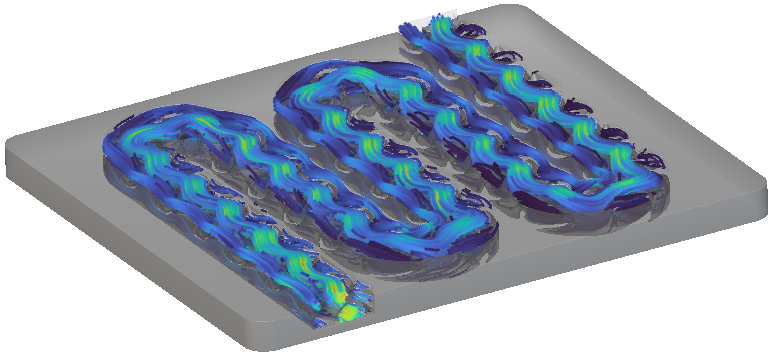
- Pressure Drop Calculation: Ensures efficient heat transfer by minimizing pressure drop and reducing energy consumption.
- Flow Regime Transition: Helps design optimal flow conditions to maximize thermal performance.
- Recirculation Zone & Vortex Detection: Eliminates dead zones that contribute to fouling and reduce heat transfer efficiency.
- Maximum Velocity Prediction: Prevents excessive velocity that could cause tube erosion and reduce exchanger lifespan.
- Flow Path Analysis: Ensures even flow through channels for optimal heat transfer efficiency.
- Flow Homogeneity: Ensures uniform fluid distribution for consistent thermal transfer and prevents localized overheating.
- Velocity & Pressure Fields: Improves design by identifying pressure losses and optimizing flow channels.
- Transient Simulation: Optimizes performance under fluctuating thermal loads for stable operation.
Manifolds
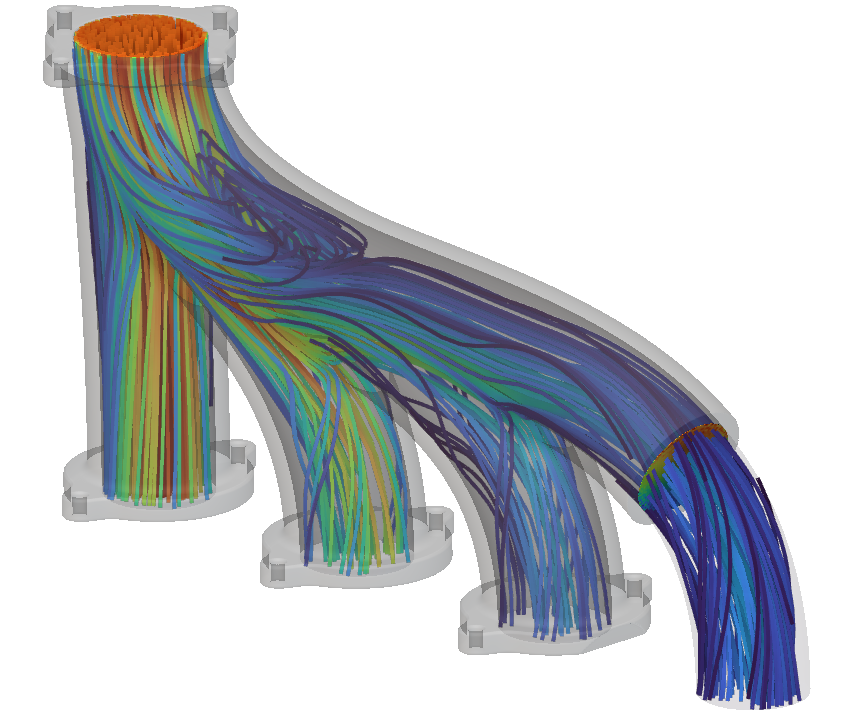
- Pressure Drop Calculation: Prevents excessive losses in fluid distribution networks, ensuring balanced flow across outlets.
- Flow Regime Transition: Ensures smooth transitions between flow regimes to prevent turbulence-induced inefficiencies.
- Recirculation Zone & Vortex Detection: Reduces stagnation points and prevents swirling flows that could cause uneven pressure distribution and fluctuations.
- Maximum Velocity Prediction: Ensures controlled velocities to prevent pressure surges and flow instability.
- Flow Path Analysis: Prevents flow restrictions that could cause pressure imbalances and inefficiencies.
- Flow Homogeneity: Balances flow between multiple outlets, reducing pressure imbalances.
- Velocity & Pressure Fields: Ensures even pressure distribution across multiple outlets for uniform performance.
- Transient Simulation: Analyses transient flow changes to prevent pressure surges and fluctuations.
Turbines
- Pressure Drop Calculation: Reduces pressure losses in cooling or lubrication systems to maintain turbine efficiency.
- Flow Regime Transition: Prevents unwanted turbulence in cooling passages that could lead to erosion or inefficiencies.
- Recirculation Zone & Vortex Detection: Prevents localized turbulence that could lead to energy losses or component wear and minimizes vortex-induced vibrations that could lead to fatigue failure.
- Maximum Velocity Prediction: Protects components from high-speed fluid erosion, improving durability.
- Flow Path Analysis: Optimizes cooling paths to prevent overheating and maintain efficiency.
- Flow Homogeneity: Improves cooling efficiency by ensuring even fluid distribution across turbine blades.
- Velocity & Pressure Fields: Reduces high-pressure zones that could cause mechanical stress and inefficiencies.
- Transient Simulation: Evaluates unsteady aerodynamics to improve efficiency and longevity.
Chemical Reactors
- Pressure Drop Calculation: Maintains proper reactant flow, preventing flow restrictions that could impact reaction rates.
- Flow Regime Transition: Maintains the correct flow regime for efficient mixing and reaction kinetics.
- Recirculation Zone & Vortex Detection: Improves reactant flow by reducing stagnant regions that lower reaction efficiency.
- Maximum Velocity Prediction: Prevents excessive shear forces that could damage delicate catalysts or particles.
- Flow Path Analysis: Enhances reactant distribution for more effective chemical processing.
- Flow Homogeneity: Ensures proper reactant mixing for uniform reaction rates and efficiency.
- Velocity & Pressure Fields: Maintains consistent reactant flow to prevent reaction inefficiencies.
- Transient Simulation: Captures dynamic flow interactions for improved reaction efficiency and process control.
Filters
- Pressure Drop Calculation: Ensures optimal pressure conditions to maintain effective filtration without excessive clogging or back pressure.
- Flow Regime Transition: Optimizes flow behavior to prevent premature clogging and maintain filtration efficiency.
- Recirculation Zone & Vortex Detection: Reduces trapped contaminants and turbulence that could clog or cause inconsistent flow through filters and ultimately reduce flow rates.
- Maximum Velocity Prediction: Avoids excessive stress on filter media, ensuring longer operational life.
- Flow Path Analysis: Identifies flow restrictions that could cause premature clogging or uneven filtration.
- Flow Homogeneity: Prevents uneven loading on filter media, extending lifespan and improving performance.
- Velocity & Pressure Fields: Prevents pressure spikes that could damage filter materials or lead to bypassing.
- Transient Simulation: Models real-time clogging behavior to optimize cleaning and replacement schedules.
These are only some of the most common applications for nTop Fluids. Other parts that can also benefit from this capability include but are not limited to manifolds, HVAC ducts, valves, flow restrictors, nozzles, diffusers, pipe bends and elbows, and orifices.