
Homogenization Considerations for Field Optimization
Homogenization Review
Field Optimization employs homogenization, a technique that allows you to extend micro-scale properties across a macro-scale problem. When using a data model that relies on homogenization (Parametric Lattice Domain, Parametric Shell-Infill Domain, and Parametric Voronoi Domain), you should consider some assumptions such as your lattice, mesh size, and specific engineering problem as homogenization is an approximation-based method.
Homogenization Advantages
- High-speed computation
- Simulates bulk large-scale behavior for large and high-density lattices
Homogenization Considerations
- Works best with high-density lattice cells
- Does not consider certain mechanical behaviors, such as lattice edge effects and stress concentrations
- Result accuracy will depend on the mesh size, the data collected, and the homogenization assumptions’ accuracy for the given engineering problem.
Lattice Optimization Considerations
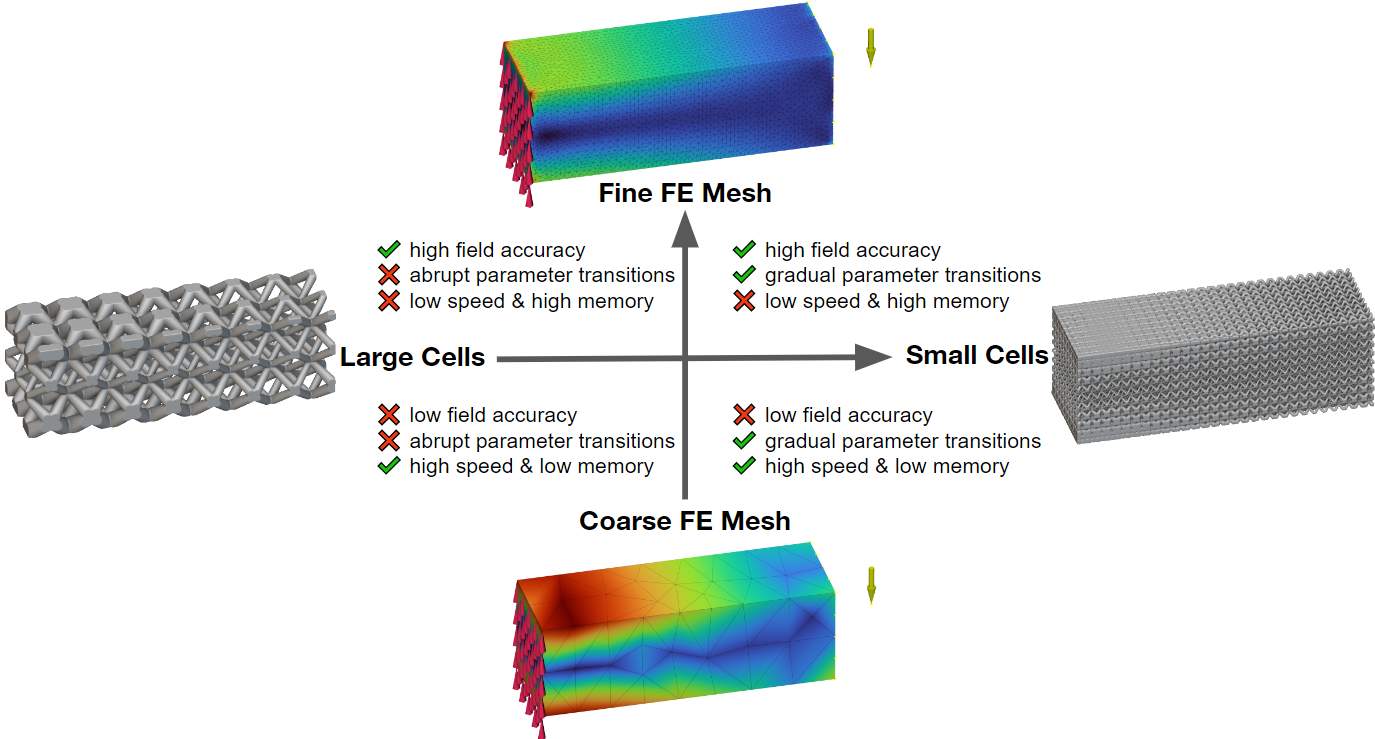
As in simulation and topology optimization, FE mesh edge length can significantly influence the accuracy of the results. Finer meshes yield more accurate results (optimal optimization outputs) but negatively affect speed and memory performance.
Another consideration for optimizing lattice structures is lattice cell size. Since larger lattice cells span greater distances across fields, they can yield abrupt parameter transitions and neglect isolated field behavior. Smaller cells see more gradual transitions and reflect more precise field data.
Finally, when optimizing lattices, consider the ratio between the design space and cell size dimensions. Since the lattice properties rely on homogenization, a considerable number of unit cells should occupy the design space to reduce the effect of the boundary and produce more accurate results. As a rule of thumb, a minimum of 10 unit cells should span each dimension (length, width, height) of the design space.
For a deeper dive into homogenization, review 342: Lattice FEA.