
Field Optimization Inputs
Like nTop’s topology optimization capabilities, Field Optimization requires a Model to store geometry/material data, an Objective function to define the optimization goal, and optional Constraints to achieve meaningful results. Use the tabs below to understand the remaining inputs.
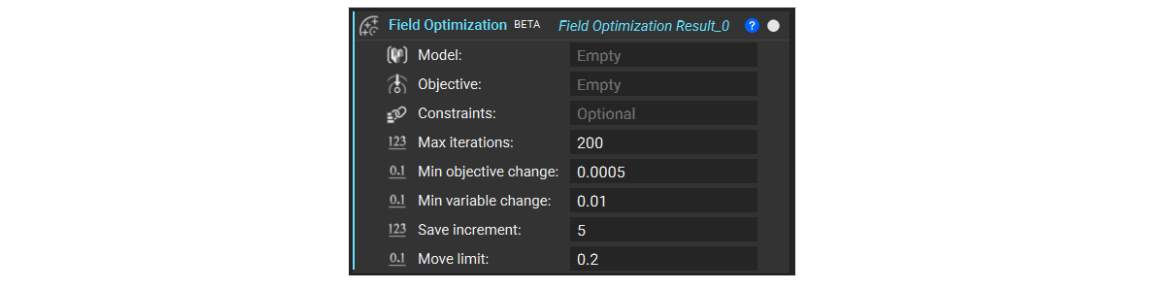
Max Iterations
Field Optimization is an iterative process that will run until the convergence criteria are met or a maximum number of iterations have been performed. The Max iterations input is required as invalid convergence criteria would otherwise result in an endless optimization loop.
Min Objective Change
The objective change is the value of the objective function between consecutive iterations. When this difference drops below the Min objective change input, the Field Optimization is considered complete (as long as the constraints are satisfied). Decreasing this number will result in more accurate results but longer computation time.
Min Variable Change
This input is a convergence threshold, as described above, but for the relative change of the design variable values from one iteration to the next. Decreasing this number will result in a more optimized result due to more frequent sampling but a longer computation time.
Save Increment
This input controls the amount of data stored and accessible after the Field Optimization process. You can increase this number to minimize the size of your completed file. The default value of 1 will save results for all increments, whereas a result of 0 will save only the first and last increments. For any value, N, greater than 1, it will save results for every N increments. Note that the final iteration will always save.
Move Limit
This value between 0 and 1 defines how much a design parameter’s value may change between iterations as a percentage of the design variable’s range. Decreasing this number will result in a more optimized result but a longer computation time.