
Thermal Boundary Conditions
A thermal FE Model must contain a set of Boundary Conditions.
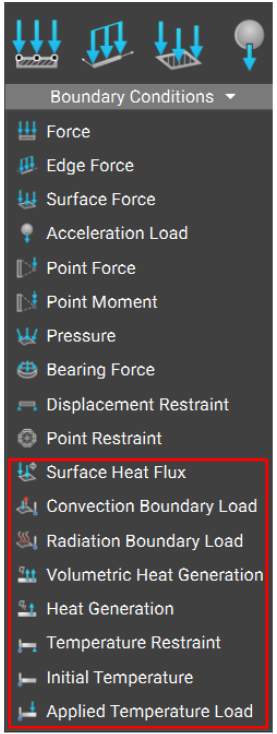
The thermal analysis-related boundary conditions (in red box) can be accessed in the Simulation tab of the ribbon.
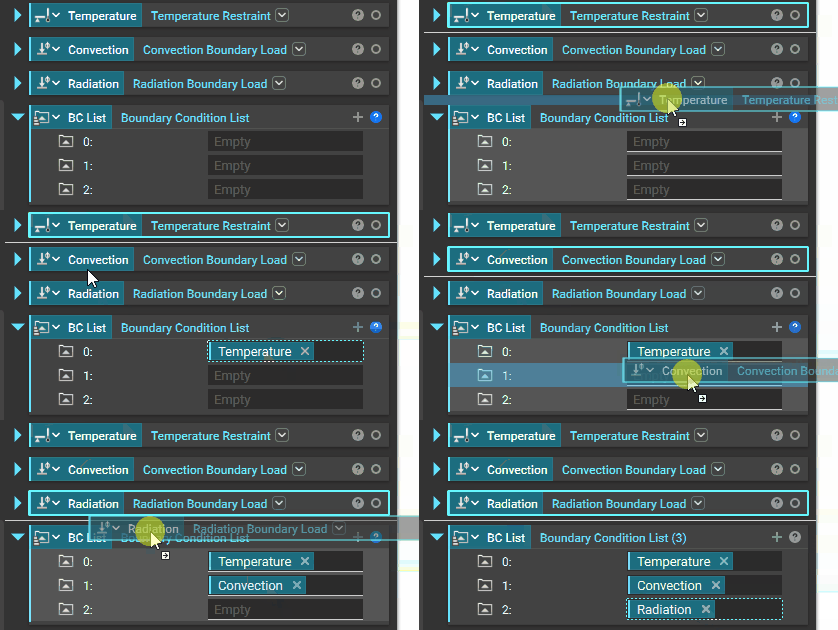
The relevant boundary conditions to a thermal analysis are defined in a Boundary Condition List block, as shown below.
The various thermal boundary conditions available in nTop are explained below.
Surface Heat Flux
Applies a distributed heat flux normal to selected boundary face entities (either CAD or FE boundary) with the input of Magnitude (can be field-based). You can reverse the heat flux direction normal with a negative sign when defining its magnitude.

Convection Boundary Load
Applies a convection load to selected boundary face entities (either CAD Face or FE Boundary) with inputs of Ambient temperature and Convection coefficient (can be field-based).

Radiation Boundary Load
Applies a radiation load to selected boundary face entities (either CAD Face or FE Boundary) with inputs: Ambient temperature and Emissivity (can be field-based).

Heat Generation
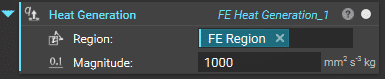
Applies a total heat generation power to a selected Region. The quantity of heat generation is distributed across the nodes based on volume fraction. The Magnitude of heat generation input is mm2s-3kg (W).
Volumetric Heat Generation
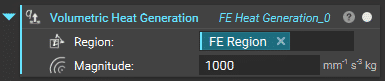
Similar to the Heat Generation boundary condition, but additionally allows the magnitude of heat generation to be field-based. The magnitude of volumetric heat generation input is mm-1s-3kg (W/m3).
Temperature Restraint
Applies a temperature boundary restraint (can be field-based) to selected Boundary entities (either CAD Face or FE Boundary).

The following boundary conditions are specific to a Thermal Stress Analysis:
Initial Temperature
Defines a baseline temperature (can be field-based) to be used in a thermal stress analysis in order to calculate the stress due to expansion/contraction based on the difference between the Initial Temperature and the Applied Temperature Load.

Applied Temperature Load
Defines an Applied Temperature (can be field-based) to be used in a thermal stress analysis to calculate the stress due to expansion/contraction based on the difference between the Initial Temperature and the Applied Temperature Load.
