Lattice Properties and Terminology
What is a Lattice?
The term “lattice” refers to any structure made from some fine pattern of material and air. In nTop, we have Graphs and Lattices. A graph type is a structure composed of beams with no thickness. A lattice can be a TPMS Structure, a custom pattern, or a graph with thickness included. Later in this course, we will use the Periodic Lattice block to generate lattices in nTop.
Lattice Properties
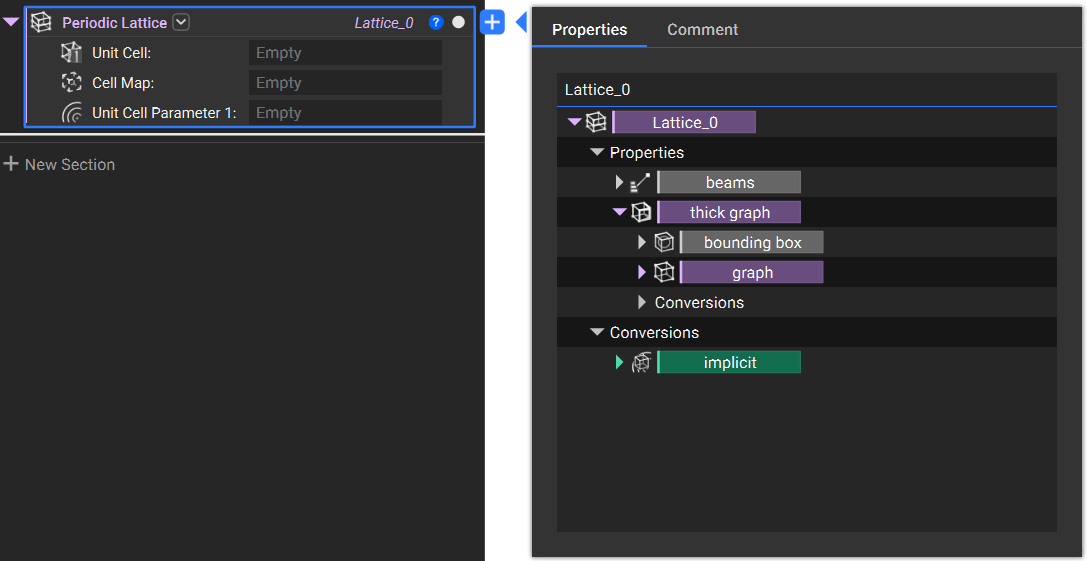
A lattice has three main properties: beams (if it is a graph lattice), implicit (to convert to an implicit body), and thick graph. To take a lattice out of the lattice body (so removing the beam thickness), you can drop down the thick graph type and use that graph. Some blocks like the Voronoi Volume Lattice have additional properties.
Graph Properties
The key properties specific to graphs include line segments, vertex count, vertex valencies, and vertices. Line segments refer to the different beams that make up the lattice. Vertices can be used to create uniform points across a body and in courses such as our 311: Ribbing and Texturing course.
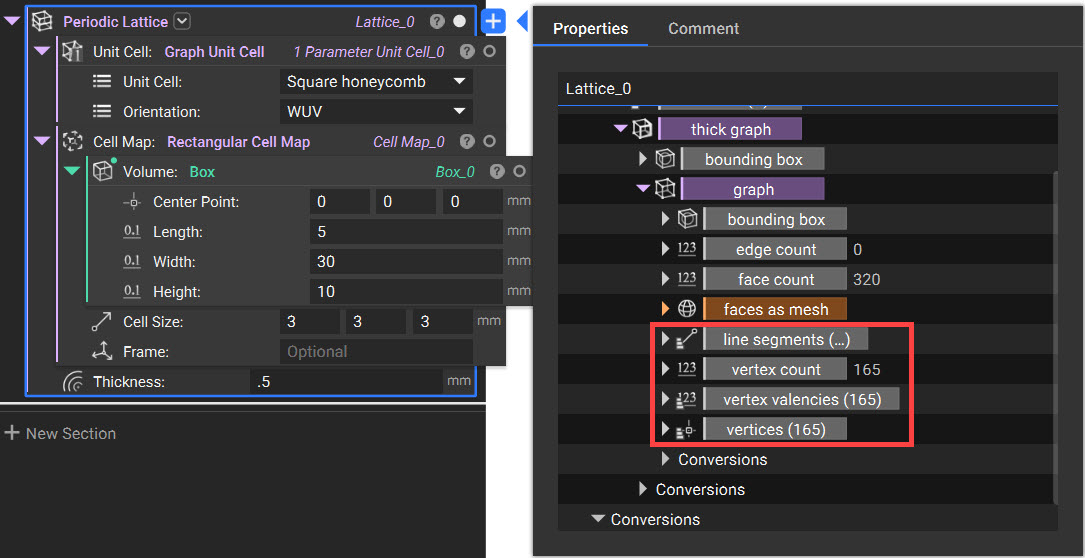
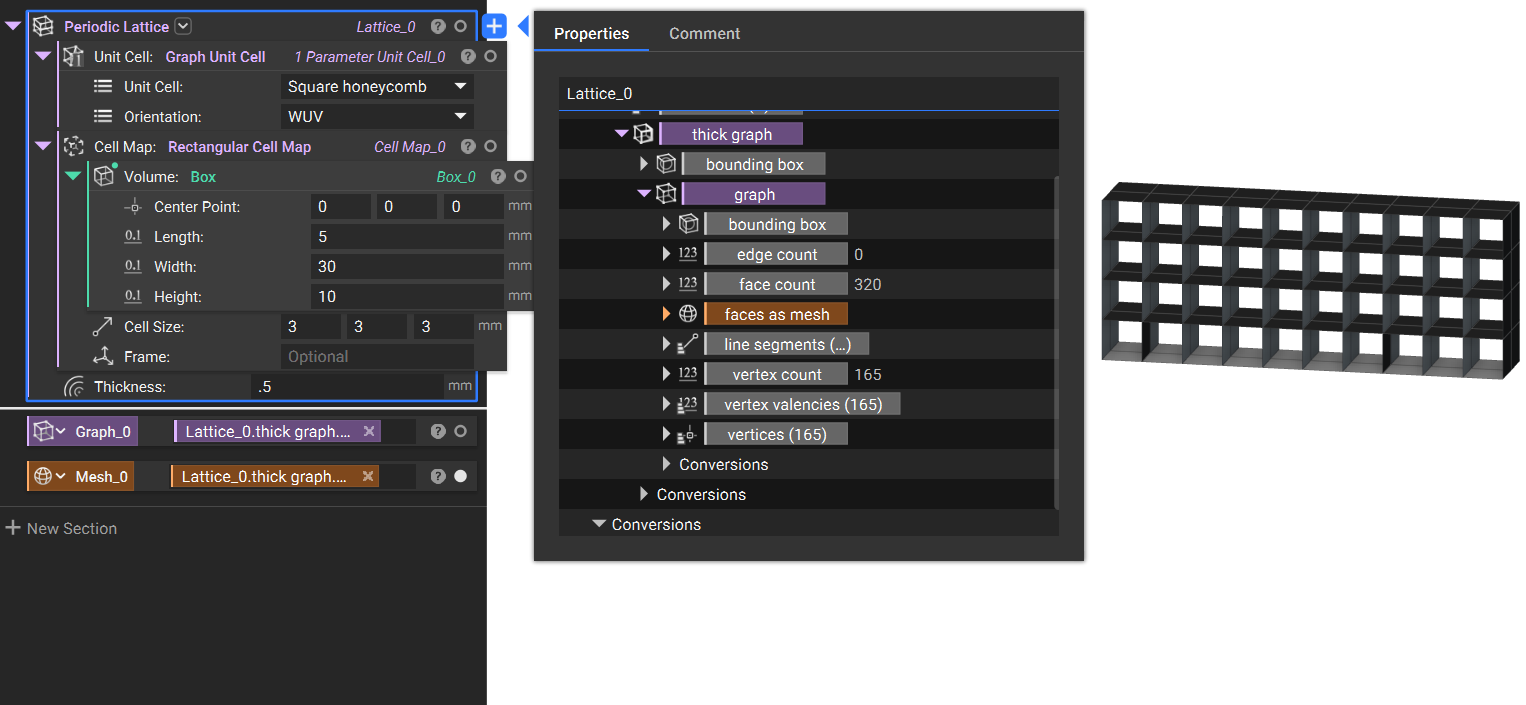
There is also a property called “faces as mesh” for the graph data type. This property allows you to extract a Mesh from a face-based Lattice automatically. You can access the Mesh in the Properties tab of the Block Information panel or by typing “your Lattice instance name.thickgraph.graph.faces as mesh” directly into an input. This property shows an error for beam-based lattices and has no output because there are no faces.