
Why do engineers use nTop?
nTop is an advanced design and simulation software that fundamentally changes how engineers generate, explore, and validate complex geometry.
Following features differentiate nTop from traditional design tools:
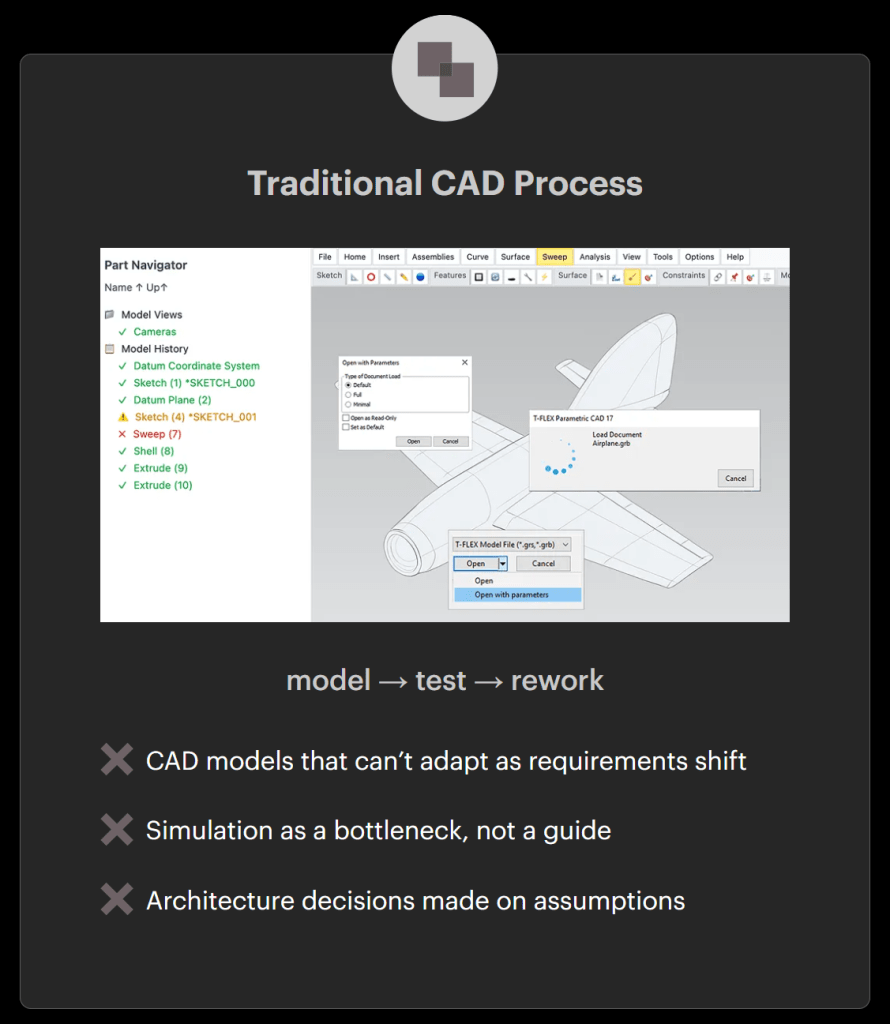
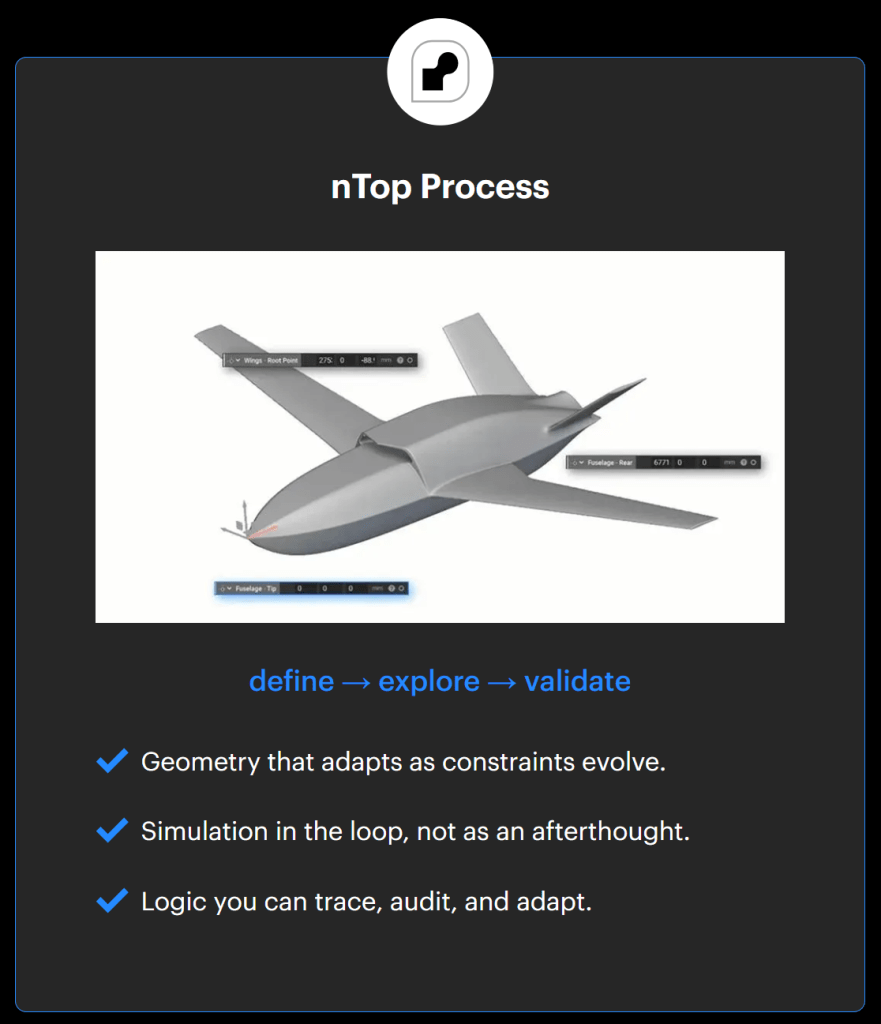
- Unbreakable parametric models for accelerated iteration: Unlike traditional Computer-Aided Design (CAD) tools, which rely on boundary representation (B-rep), nTop uses implicit modeling. This allows for broad parametric changes without the geometry breaking or failing to rebuild. By eliminating geometry fragility and meshing delays, nTop reduces the time required to generate and evaluate thousands of design variants. You can explore a vast design space of options systematically, leading to faster convergence on optimal designs.
- Integrated simulation for smarter prototyping: nTop enables meshless analysis for integrated structural (FEA) and aerodynamic (CFD) analysis. This eliminates the time-consuming bottleneck associated with traditional meshing and simulation tools, allowing you to get physics insight instantly without lengthy meshing, setup and simulation steps. This simulation-in-the-loop exploration allows you to build a superior understanding of the design space and key tradeoffs (aerodynamic, structural, performance)and make design decisions with high confidence.
- Logic-driven workflow for scalable engineering: nTop captures engineering intent as reusable design logic similar to an executable code with input parameters that can be varied to create various design configurations. This transforms manual iteration into systematic intelligence gathering, making workflows more efficient and repeatable for large-scale projects.
To help you understand what makes nTop unique and how it enables rapid iteration for high-performance designs, let’s hear directly from our founder who will explain the vision and principles behind the platform.
Transcript
nTop is a company. We’re here, based in New York City. nTop is a software that we release for engineers to model some of their most complex designs, from, you know, systems-level aircraft models all the way down to like really detailed heat exchanger models. You know, when I started nTop, there was a mismatch in the tools that we as engineers use to design and iterate through a design and come up with what a design looks like, what a design should be, versus the tools that we use to like detail out and draw a design. And so when you look at the tools that we use, you know, traditional CAD software, traditional simulation finite element based simulation tools, you know, all those tools are incredible when you need to like detail out a design. Like, those are the best drafting tools ever. But like, if you’re trying to figure out what the design is and iterate through a design and, you know, maybe you have an aircraft where you’re parameterizing different sweeps of a wing, trying to actually vary those and calculate the performance for each design point is painful and slow. And so we built nTop to remove that bottleneck, and we did so on this really amazing new technology that you’re going to learn about today called implicit modeling.
One of the main problems that we’ve built nTop to solve is, you know, you have this like brilliant idea of how you would parameterize a design. You know, maybe it’s an aircraft and you’re trying to say, “Okay, I have this inlet duct design. I want to see what happens if the inlet duct is in a certain location with respect to the fuselage.” Or maybe it’s like a heat exchanger and you’re like, “Okay, I have these inlets to the heat exchanger. I have some set of tubes that are going through that are twisting around.” And, you know, there’s hot fluid in one, cold fluid in another. But like, what is the size of the tubes? What’s the orientation of the tubes? Where should the inlets go? Should they be together on the top? Should they be on the sides? And you want to explore all of that design space. nTop is like the best tool for constructing that model and very rapidly understanding the performance of each of those design points. And so that’s like the core problem that we built nTop to solve is very quickly and easily building up parametric design spaces and then exploring those parametric design spaces to understand performance of each of those, you know, sets of design parameters that come together so that you can hone in on what those design parameters are and do all of your detailing out from there.
The advice I would give for you as a new user to nTop is think of nTop like you’re building a program, and the 3D geometric solid model that comes out is the result of that program. So you’re building in a set of logical operations to construct that model, and the more you could lean into like the implicit modeling techniques of constructing those geometric objects, how you fillet and blend, you know, how you parameterize a two-panel wing, and how you generate a wing from a set of, you know, air foil profiles, how you use implicit modeling techniques to generate lofted surfaces, the more you lean into that, you’re going to build up these superpowers of nTop knowledge which allow you to build these models that are rock solid, 100% robust, and really, really fast to iterate through. So I want to thank everybody for joining and picking up nTop for the first time. It’s always amazing to see all the incredible things that you’re going to build and your learning journey, and, you know, as usual, if you’re stumped on anything, reach out. We’re here to help and can’t wait to see what you make.
0:00 What is nTop?
0:46 Problems nTop Solves
1:40 Advice for New nTop Users