
TPMS Unit Cells
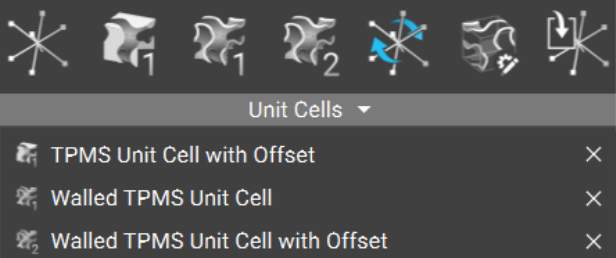
We can also create TPMS Structures using the blocks below along with our graph-based lattices.
TPMS stands for triply periodic minimal surface, and these structures are created from the sine and cosine equations. These surfaces form continuous, periodic structures when stacked in the x-, y-, or z- directions. See our support article here to build your own TPMS from an equation.
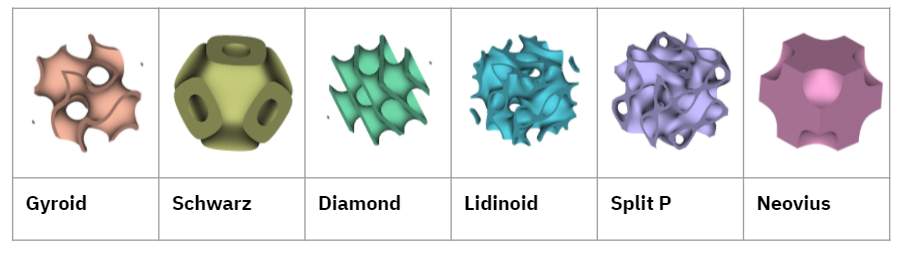
The gyroid and broader family of triply periodic structures inherently have two sides or fluid domains, making them natural candidates for heat exchanger applications. They can be easily tailored or offset differently to alter stiffness and/or flow properties.
Three blocks allow you to select a unit cell from a library of TPMS Unit Cells.
Walled TPMS Unit Cell
This block is a 1 Parameter Unit Cell, requiring one parameter to define it. The Unit Cell’s parameter is the thickness of the TPMS walls.
TPMS Unit Cell with Offset
This block is a 1 Parameter Unit Cell, requiring one parameter to define it. The parameter is the mid-surface offset of the TPMS, which is either a positive or negative distance. The Mid-surface offset wall shifts inward for negative values and outward for positive values.

Walled TPMS Unit Cell with Offset
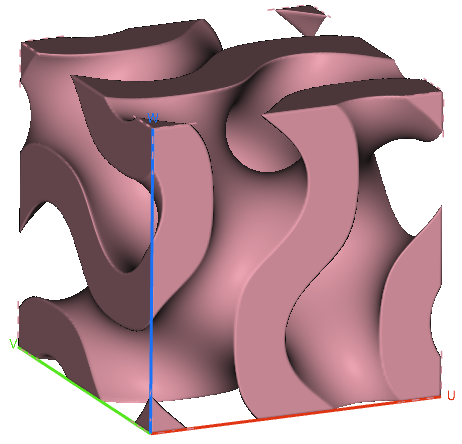
This block is a 2 Parameter Unit Cell, requiring two parameters to define it. The first parameter is the thickness of the TPMS walls, shown as T in the image below. The second parameter is the Mid-surface offset distance of the TPMS, shown as D in the image below.
The offset can be a positive or negative distance. When viewing the Unit Cell in Front view, positive values move the mid-surface left, and negative values move it right.

Note: The Approx. thickness and Mid-surface offset inputs are approximate values, so the thickness and offset will vary based on the input provided. If you need Exact Thickness, we recommend using the overload on these TPMS Unit Cells and toggling the Exact Thickness checkbox.
Some applications of our TPMS structures include biomedical devices, supports for printing, and heat exchangers.