Design Responses
When running the Topology Optimization on your FE Model, you must specify the objective to meet and a constraint to your solution. The following responses are used to define both criteria. These design responses are ordered by how commonly they are used (the most used is the Structural Compliance Response).
Structural Compliance
The Structural Compliance Response block allows user control over part stiffness. Compliance is the inverse of stiffness. Minimizing compliance, as an Optimization Objective, will maximize model stiffness.

Stress
At every optimization step, the Stress Response block evaluates the maximum centroidal von Mises stress in an FE Boundary. It takes a list of boundary conditions as part of a static analysis.
Note that this yields a longer solution time, as a full-body static structural simulation is conducted at each time step to determine the stresses imposed upon the part.

Note: Setting the loaded regions passive can ensure a more optimal solution.
Displacement
The Displacement Response lists boundary conditions as part of Static Analysis. This block evaluates a node’s maximum displacement/deformation within a mesh of an FE Boundary at every step of your topology optimization.
Note that this yields a longer solution time, as a full-body static structural simulation is conducted at each time step to determine the individual node deformations.

Note: Setting the loaded regions passive can ensure a more optimal solution.
You may also select a direction you would like to track the displacement (E.g., the total magnitude or simply in the x-y axis, etc.)
Volume Fraction
The Volume Fraction Response is based on the volume fraction of optimized geometry divided by design space volume. This block is rarely used as an optimization objective. Instead, consider using the Volume Fraction Constraint block to reduce material below a certain value.

Natural Frequency
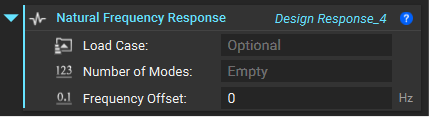
The Natural Frequency Response evaluates the model on several modes and attempts to maximize or minimize them. As part of a natural frequency analysis, you can optionally list a set of restraint boundary conditions.
Note that this yields a longer solution time, as a modal analysis is conducted at each time step to determine the natural frequencies.