
Different Types of Fields in nTop
You will see a variety of fields in nTop. Depending on your application and requirements, you can use these fields to drive of spatial variation of numerous design parameters.
Fields of Implicit Bodies
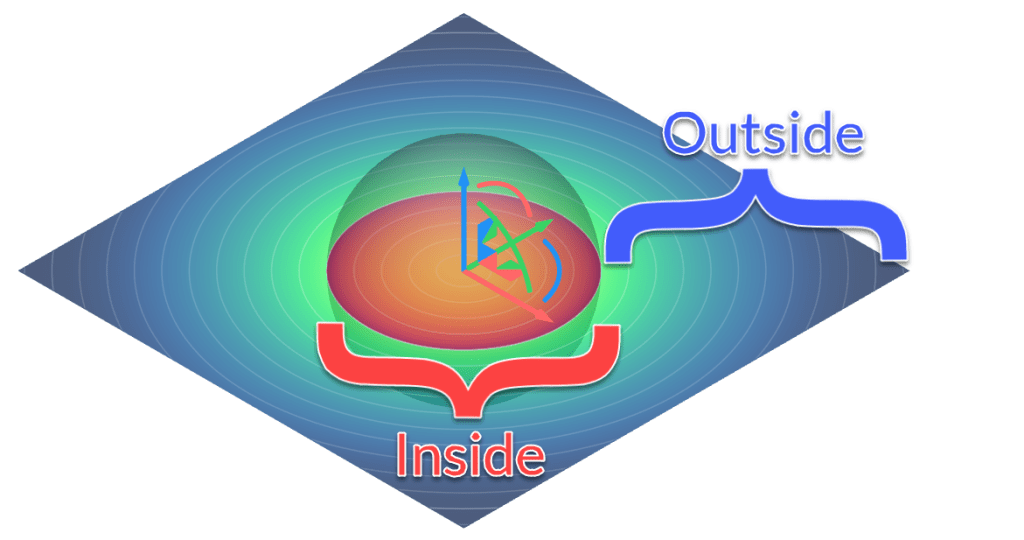
As explained in 101: nTop Essentials, implicit bodies in nTop are represented by signed distance functions that describe their shapes and give information about where the inside and the outside regions are. They also have distance units, which are mm by default in nTop.
You can identify a field that is a signed-distance function by its parallel and equally spaced contour lines in the Field Viewer.
Fields of Planes, Points, and Axes
Planes, points, and axes are some of the simplest fields in nTop.
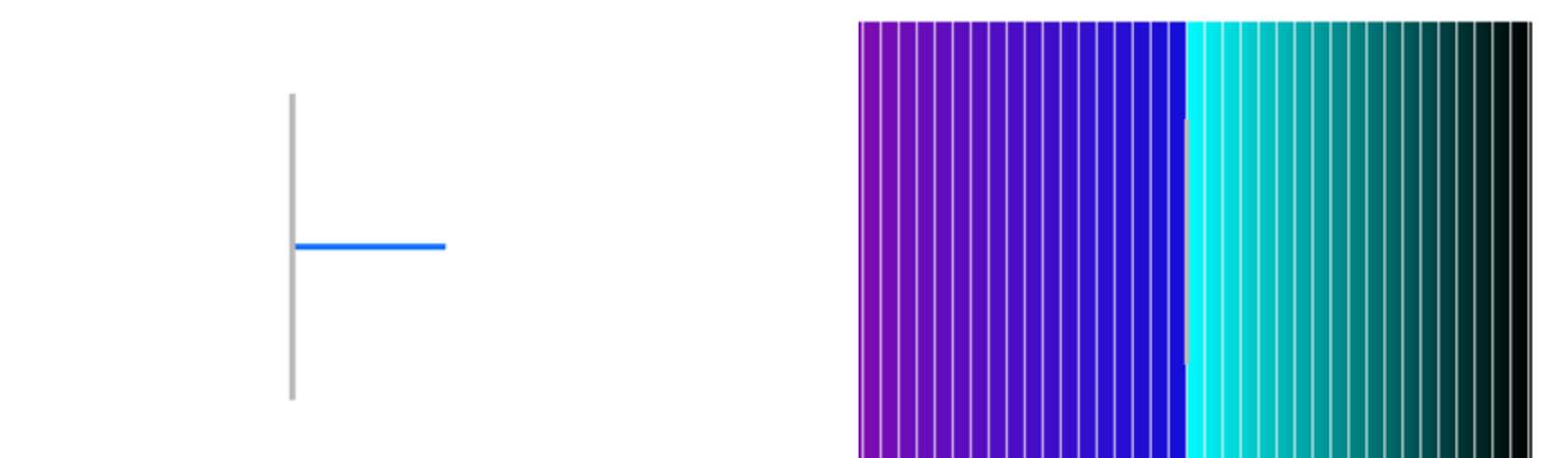
The field of a plane has all positive values to one side of the plane, in the direction of the normal, and all negative values on the other side. As this is a distance field, its values increase in magnitude the farther away it is from the plane.

The field of a point is completely positive and has radially increasing values in all directions moving away from the point.

An axis also has a field with all positive and radially increasing values, similar to that of a point. The values are constant along the axis’s length and increase in both directions moving away from the axis.
Periodic and Noise Fields
Unbounded and dimensionless scalar fields of varying patterns can be found in the Fields tab.

The Periodic options include Gyroid, Diamond, Schwarz, Lidinoid, SplitP, and Neovius patterns.
The two 3D noise options include Simplex Noise and Cellular Noise. They are composed of pseudorandom values and are typically used for texturing applications.
For more information on these blocks, go to Documentation → Block Documentation → Blocks → Fields.