
Plenums and Baffles
We can use several methods to increase the effectiveness of TPMS heat exchangers. As you might expect, higher flow velocities, uniform flow distribution, inducing turbulence, and swirling are some methods you can use to make your heat exchanger more efficient. The TPMS Manipulation section in HEX Design Part 1: Intro to Two-Channel Heat Exchangers mainly focused on how you can achieve this inside the lattice. In contrast, this one primarily focuses on geometries and shapes outside the immediate HEX core to help achieve the same goals.
In this course, we will discuss Plenums & Baffling, which can prevent fluid types from mixing and encourage better flow distribution into the HEX core.
Plenums
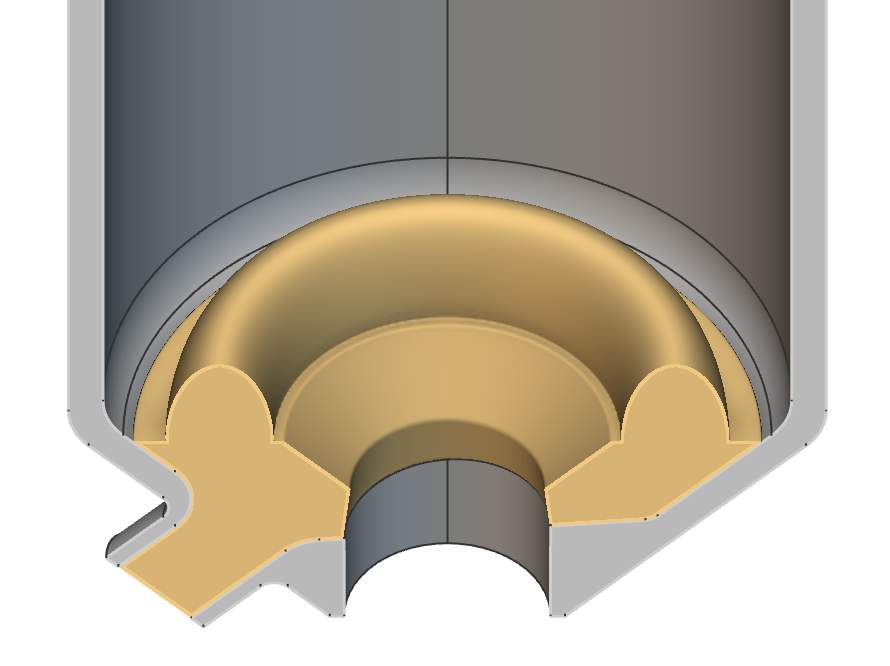
We use plenums to gradually introduce a fluid into the heat exchanger core, which helps evenly distribute the flow while addressing immediate pressure drop into the heat exchanger unit as a whole. See Image 2 below.
Considerations for plenums:
- Design for Manufacturability
- Shell/Casing/OML shaping
- See the Pre-nTop Prep section
Baffling
We use plenum baffles to prevent two or more fluids from mixing and are typically introduced at the entrance and exit of the core.
We use physical and virtual baffles to lengthen the fluid flow path into the core. Both physical and virtual baffles have their use cases.

Physical Baffles (The focus of this section)
In a HEX example different from this course (Image 1 below), there are six total baffles. Four at the inlet/outlets prevent the fluids from mixing, and two internal baffles are used to lengthen the flow path.
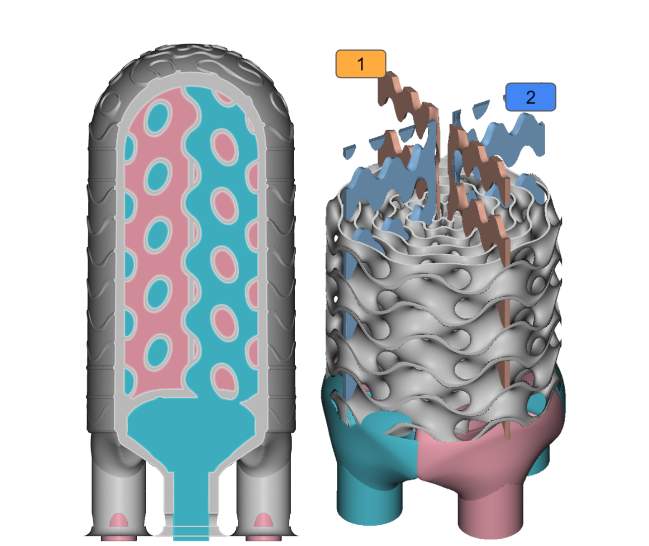
Image 1: The left-most picture shows the overall HEX with the fluid domains visible. The right-most image shows the baffles with a partial HEX Core. The baffles that prevent the fluids from mixing are in Red/Green at the bottom, located at the inlets and outlets. The physical baffles running up through the core are used to length the flow path of the fluid. Baffle (1) routes the cold fluid while baffle (2) routes the hot fluid.

Image 2: This image shows four different views of the inlet/outlet baffles. These pictures and the left-most picture in Image 1 show how the plenums transition into the HEX Core. Notice in the bottom two images, IF we go straight from the inlet/outlet piping into the HEX Core, there is little cross-sectional flow area. This is one reason why plenums are so important.