
Transfer Function Block
The Transfer Function block works very similarly to multiple mini ramps put together. This block gives you more control over the changes throughout the domain.
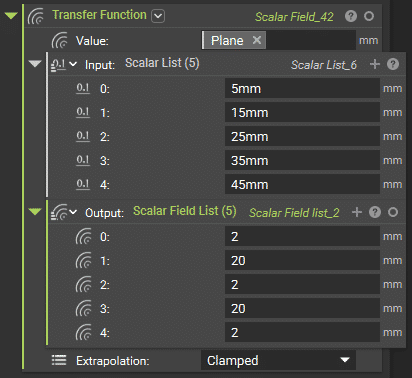
Instead of taking in minimum and maximum input and output values like the Ramp block, the Transfer Function requires lists of values as it uses piecewise interpolation to compute the output field value of a function approximated by a set of field data points.

- Value: The field driving the Transfer Function, a reference for the input domain.
- Input: Pre-populated as a Scalar List for a user-defined set of values.
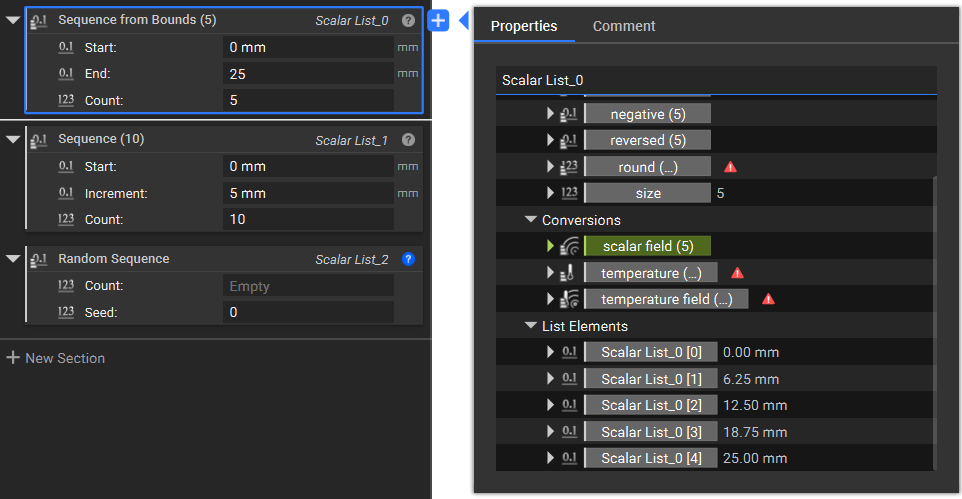
You can use the Sequence from Bounds, Sequence, or Random Sequence blocks for incremented or random set of values. You can find these in the Math tab of the Ribbon under Utilities. To learn more about using these sequence blocks, visit our 230: Intro to Automation course.
- Output: A Scalar Field List of output values. The length of this list should match the length of the Input list.
Note: When defining the Input and Output values, make sure to include units.
- Extrapolation: How the output values extend beyond the specified input domain. See the image below for a comparison of the two options.
- Clamped: Bounding output values remain constant beyond the specified domain
- Linear: Linear extrapolation of output values beyond the specified domain
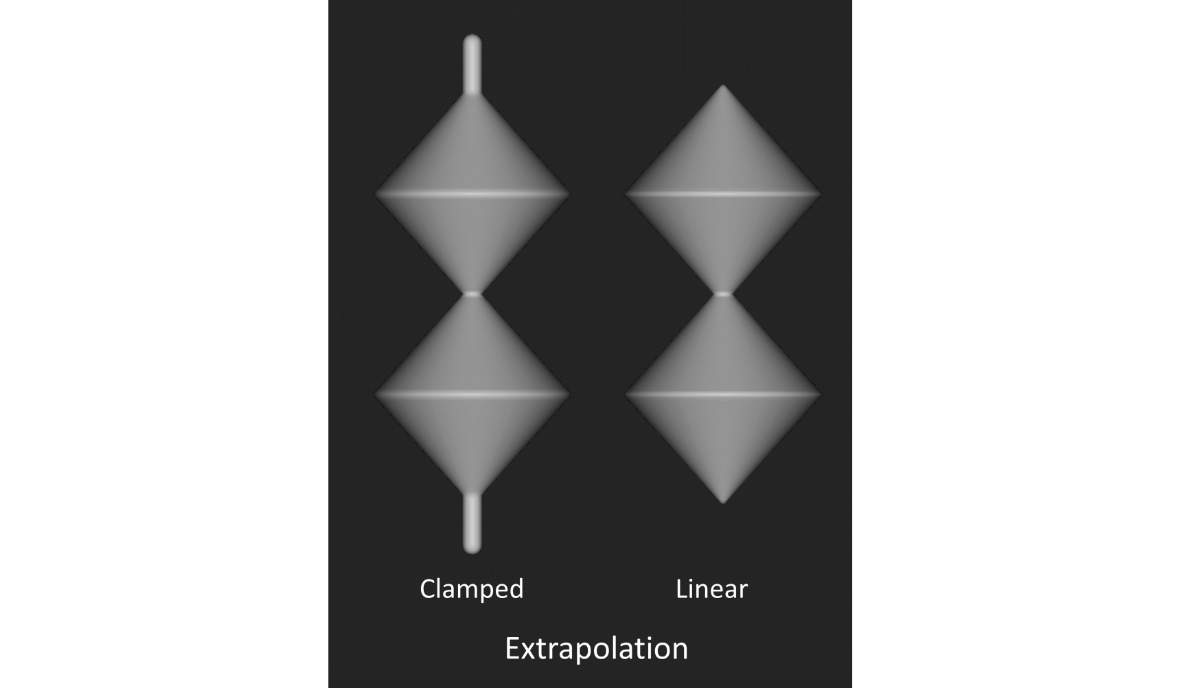
Example of the two extrapolation options
Example Application

Advanced manipulation of beam thickness and density of a Voronoi lattice using a Transfer Function